
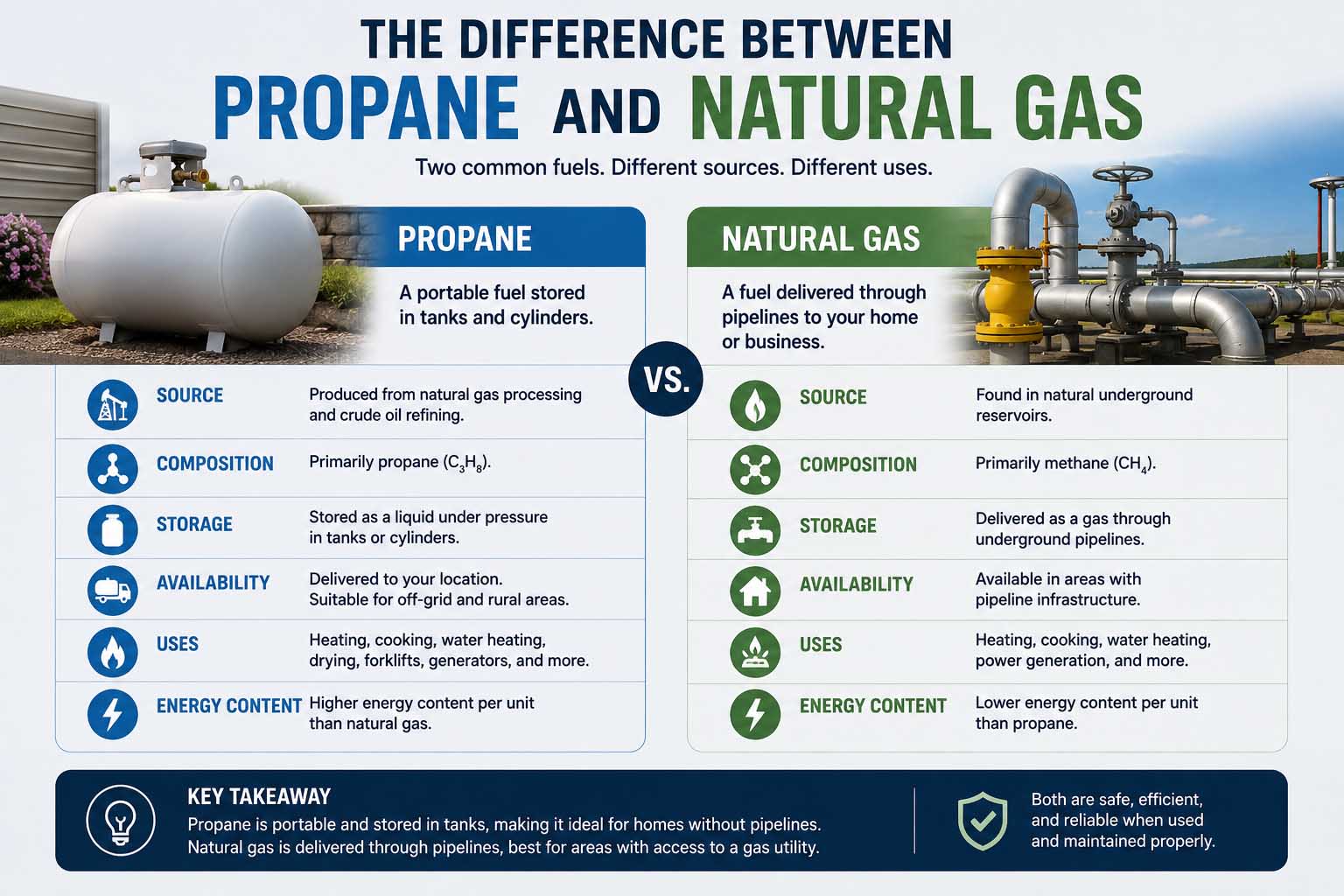
Difference Between Propane and Natural Gas: Which Fuel Is the Better Choice?
If you’re choosing a fuel source for your home or business, understanding the difference between propane and natural gas can save money and help you select the right energy solution. Both fuels power heating systems, water heaters, stoves, generators, and industrial equipment, yet they differ in how they’re produced, delivered, stored, and priced.
While propane offers portability and flexibility, natural gas provides continuous fuel through underground pipelines. Knowing how each option works makes it easier to match the fuel source to your property, operational needs, and long-term budget
Difference Between Propane and Natural Gas at a Glance
The easiest way to compare these fuels is by looking at their basic characteristics.
- Natural gas is delivered through underground utility pipelines directly to homes and businesses.
- Propane is stored as a liquid inside pressurized tanks and delivered by truck when refills are needed.
Although both belong to the hydrocarbon family and burn cleanly compared to many other fossil fuels, they are not interchangeable without equipment designed for each fuel.
| Feature | Propane | Natural Gas |
|---|---|---|
| Main Component | Propane (C₃H₈) | Mostly Methane (CH₄) |
| Delivery Method | Storage tank | Underground pipeline |
| Storage | On-site tanks | No on-site storage needed |
| Energy Density | Higher | Lower |
| Availability | Almost anywhere | Areas with gas infrastructure |
| Common Uses | Rural homes, farms, mobile businesses | Cities, suburbs, commercial buildings |
What Is Propane?
Propane is a liquefied petroleum gas (LPG) produced during natural gas processing and crude oil refining.
Under moderate pressure, propane becomes a liquid, making it easy to transport and store in tanks of various sizes.
Because it can be delivered almost anywhere, propane is widely used in:
- Rural homes
- Farms
- Restaurants
- Food trucks
- Construction sites
- Warehouses
- Backup generators
This flexibility makes propane popular in locations where pipeline infrastructure is unavailable.
What Is Natural Gas?
Natural gas is primarily composed of methane and is extracted from underground gas reservoirs.
After processing, it travels through an extensive pipeline network before reaching homes and businesses.
Unlike propane, natural gas remains in gaseous form during normal use and doesn’t require on-site storage.
To better understand where natural gas fits into everyday energy use, it’s helpful to know What Are Utilities, since natural gas service is commonly provided alongside electricity and water by utility companies.
Difference Between Propane and Natural Gas: Energy Content
One of the biggest differences is energy density.
Propane contains more energy per unit of volume than natural gas.
Approximate values include:
- One gallon of propane: about 91,500 BTUs
- One cubic foot of natural gas: about 1,030 BTUs
Because propane contains more energy in a smaller volume, it is often preferred for portable applications and locations with limited storage space
What’s the Difference Between Propane and Natural Gas in Cost?
Fuel costs vary by region, supplier, and market conditions.
Natural Gas
Natural gas generally costs less per unit of energy in areas served by established pipeline networks.
Its pricing tends to remain relatively stable because supply is continuous.
Propane
Propane prices often fluctuate based on:
- Seasonal demand
- Transportation costs
- Local suppliers
- Storage availability
Although propane usually costs more per unit of energy, properties without pipeline access may still find it to be the most practical solution.
When comparing fuel options, many homeowners naturally ask What Are Two Questions That Smart Spenders Ask Before Making a Purchase. Thinking about both the upfront cost and the long-term operating expense is a smart way to evaluate either fuel.
Installation Requirements
Installation differs considerably between these fuel sources.
Propane Installation
A propane system usually requires:
- Storage tank
- Pressure regulator
- Fuel lines
- Scheduled fuel deliveries
The tank may be installed above ground or underground depending on local regulations and property layout.
Natural Gas Installation
Natural gas typically requires:
- Access to a municipal gas pipeline
- Utility connection
- Gas meter
- Interior gas piping
Once connected, fuel is supplied continuously without requiring deliveries.
Business Applications
Businesses choose fuel sources based on location, operating costs, and equipment requirements.
Common Propane Applications
- Food trucks
- Hotels
- Agricultural operations
- Manufacturing
- Forklift fleets
- Emergency generators
Common Natural Gas Applications
- Office buildings
- Restaurants
- Hospitals
- Hotels
- Retail centers
- Manufacturing facilities
Large commercial properties often prefer natural gas because pipeline delivery eliminates concerns about fuel storage capacity.
Efficiency Comparison
Many people assume propane is always more efficient because it contains more energy.
In reality, efficiency depends on several factors:
- Appliance design
- Equipment maintenance
- Insulation
- Operating conditions
- Fuel pricing
Modern high-efficiency furnaces are available for both propane and natural gas.
The fuel itself matters less than selecting properly sized equipment and maintaining it regularly.
Safety Differences
Both fuels are considered safe when installed and maintained correctly.
Manufacturers add odorants to both gases so leaks are easier to detect.
Even so, there are some differences.
Propane Safety
Because propane is heavier than air, leaked gas tends to collect near the ground or in low areas.
Proper ventilation is essential.
Natural Gas Safety
Natural gas is lighter than air.
When released outdoors or into ventilated spaces, it generally rises and disperses more quickly.
Regardless of fuel type, professional installation and regular inspections remain the best way to reduce safety risks.
Environmental Impact
Both propane and natural gas burn cleaner than coal or heating oil.
Natural gas generally produces slightly fewer carbon dioxide emissions per unit of energy burned.
Meanwhile, propane generates fewer particulate emissions than many traditional fuels and produces very little soot.
Businesses looking to reduce emissions often evaluate both options alongside renewable energy sources as part of broader sustainability initiatives.
Can Appliances Use Both Fuels?
Not without modification.
Although propane and natural gas power many of the same appliances, they operate at different pressures and require different burner sizes.
Common appliances include:
- Furnaces
- Water heaters
- Fireplaces
- Outdoor grills
- Commercial kitchen equipment
- Backup generators
Many manufacturers sell conversion kits, but these should only be installed according to manufacturer specifications and local safety codes.
Difference Between Natural Gas and Propane for Rural Areas
Location often determines the better choice.
Propane Works Well For
- Farms
- Cabins
- Rural homes
- Construction sites
- Mobile businesses
Since propane doesn’t rely on underground utility infrastructure, it can serve nearly any location.
Natural Gas Works Well For
- Urban neighborhoods
- Commercial districts
- Apartment buildings
- Industrial parks
If pipeline service already exists, natural gas often provides the most convenient long-term solution.
Common Misunderstandings
Several myths continue to create confusion.
Myth: Propane and natural gas are identical.
Although both are gaseous fuels, they have different chemical compositions, pressures, and energy content.
Myth: Propane appliances automatically work with natural gas.
Appliances generally require conversion kits or separate models designed for each fuel.
Myth: Natural gas is always cheaper.
Pipeline access, installation costs, and regional fuel pricing all affect long-term operating expenses.
Choosing the Right Fuel for Your Business
When deciding between propane and natural gas, consider these questions:
- Is pipeline access available?
- How reliable is local fuel delivery?
- What is the total installation cost?
- Will future expansion require additional fuel capacity?
- How often will equipment operate?
- What are the long-term maintenance costs?
Companies operating multiple facilities also benefit from standardized fuel management. While often associated with warehousing, the benefits of inventory visibility include better tracking of consumable resources such as propane supplies across different locations.
Frequently Asked Questions
What is the difference between propane and natural gas?
Propane is stored as a liquid in pressurized tanks, while natural gas is delivered continuously through underground pipelines. They also differ in energy content, storage requirements, and appliance compatibility.
What’s the difference between natural gas and propane?
Natural gas is primarily methane and usually serves properties connected to utility pipelines. Propane is a liquefied petroleum gas that can be transported and stored almost anywhere.
Is propane more expensive than natural gas?
In many regions, propane costs more per unit of energy than natural gas. However, the overall cost depends on local pricing, installation expenses, and fuel usage.
Can you switch from propane to natural gas?
Yes, but many appliances require manufacturer-approved conversion kits or replacement components to operate safely.
Which fuel is better for businesses?
Businesses with reliable pipeline access often choose natural gas because of continuous supply and predictable delivery.
Making the Best Fuel Choice
Understanding the difference between propane and natural gas makes it easier to choose a fuel that fits your property, budget, and operational needs. Natural gas offers convenience through continuous pipeline delivery, making it a strong option for homes and businesses in serviced areas. Propane provides flexibility, higher energy density, and dependable performance in locations where pipelines aren’t available. Before making a decision, compare installation costs, ongoing fuel expenses, equipment compatibility, and future energy requirements to find the solution that delivers the best long-term value.